
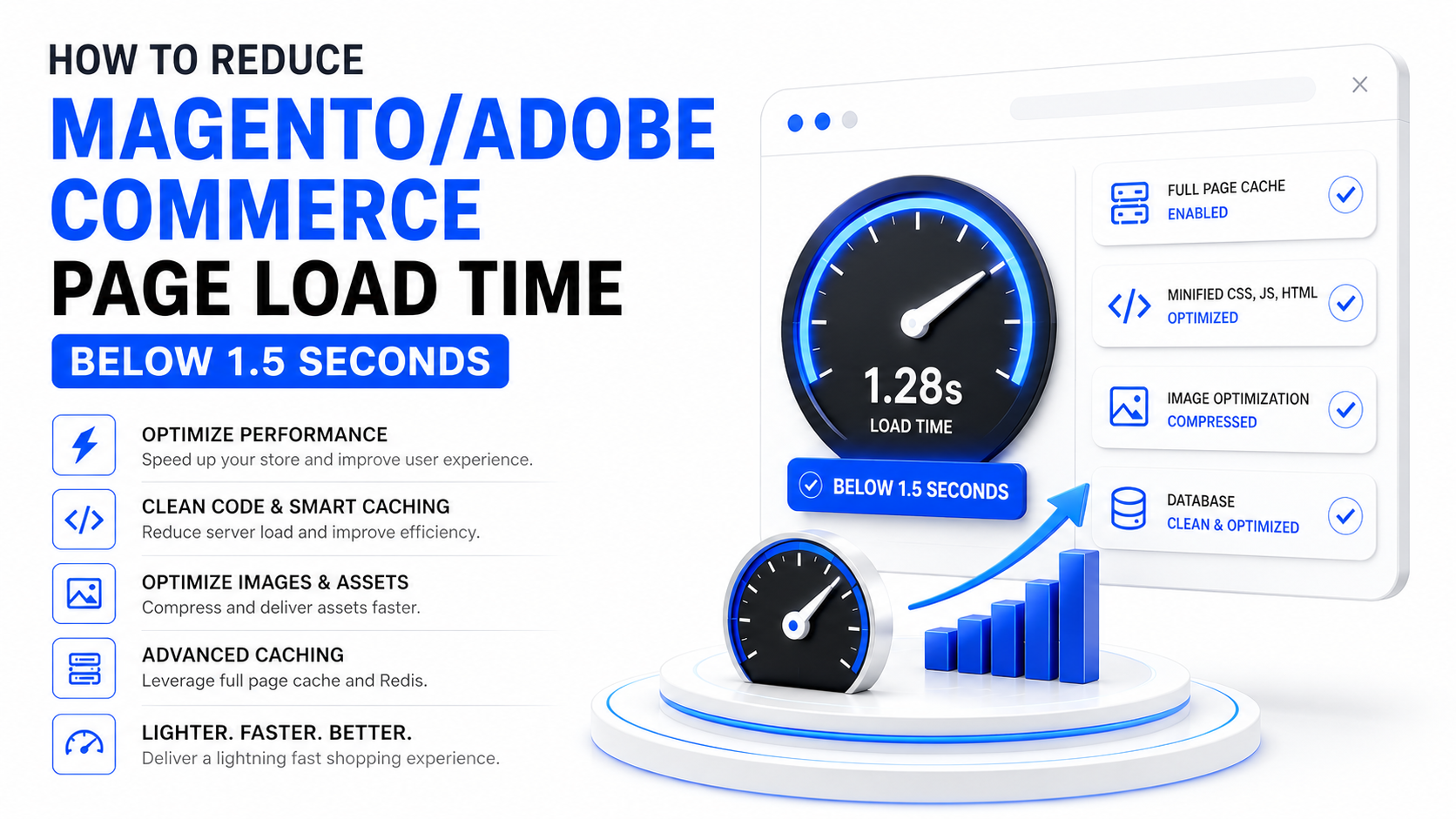
Ultimate Magento Speed Optimization: Drastically Reduce Load Time Below 1.5 Seconds
An exhaustive, enterprise-grade blueprint for engineering high-performance storefronts, increasing conversions, and dominating Core Web Vitals in 2026.
When it comes to Magento speed optimization, the financial stakes have never been higher for enterprise brands. Superficial fixes simply don't work anymore.
Picture this scenario: It is the morning of Black Friday. A premium UK-based B2B industrial equipment supplier, generating over £25 million in annual online revenue, had just launched their most aggressive promotional campaign of the year. The marketing team had spent months optimizing their Meta Ads. As the clock struck 8:00 AM, traffic spiked by 400% within the first hour.
The initial mood was celebratory—until the customer support lines started ringing, and the Slack notifications turned from green to a panicked red.
"The checkout is hanging at the payment gateway."
"Category pages are taking 6 to 8 seconds to load."
"We are seeing massive 502 Bad Gateway errors across the site."
Despite spending heavily on customer acquisition, their bounce rate shot up by an unprecedented 106%. A 4.2-second load time is not just a technical glitch; it is a silent, catastrophic revenue killer.
If your Adobe Commerce store takes longer than 1.5 seconds to load, you are bleeding money. In today's hyper-competitive digital landscape, relying on basic caching plugins is a recipe for failure. You need a systemic, enterprise-grade approach to architecture, caching, codebase hygiene, and frontend delivery.
Here at Creativephy, we engineer high-ticket, performance-driven custom web solutions for global brands. This guide is the exact, uncompromised blueprint we use to execute Magento speed optimization and bring load times under that critical 1.5-second threshold.
Chapter 1: The Economics of Magento Speed Optimization in 2026
Before we touch a single line of PHP or adjust a server configuration, we must understand the financial imperative of speed. Performance is not a developer vanity metric; it is the foundational pillar of your digital marketing ROI.
The True Cost of Latency on Customer Acquisition
You are likely investing heavily in Meta Ads and Google Ads to drive targeted traffic to your store. In 2026, Cost Per Click (CPC) and Cost Per Acquisition (CPA) are at all-time highs. If you pay $2.50 for a click, and the user abandons the site because the hero image took three seconds to render, you have burned that capital entirely.
Let's look at the mathematics of page speed and conversion. The industry standard dictates that a site loading in 1 second has a conversion rate roughly 3x higher than a site loading in 5 seconds. If your Average Order Value (AOV) is $150, and you receive 100,000 visitors a month, proper Magento speed optimization shifting your load time from 4.5s to 1.5s can double your gross revenue purely through technical infrastructure.

Chapter 2: Infrastructure and Server-Level Mastery (The Engine)
Effective Magento speed optimization cannot be built on a slow engine. Adobe Commerce is a monolithic, resource-heavy application. It requires immense computational power. If you are running a high-SKU catalog on shared or under-resourced cloud hosting, no amount of frontend tweaking will save your conversion rates.
2.1 Dedicated Cloud Architecture vs. Legacy Hosting
Move entirely off legacy virtual private servers (VPS) or shared environments. You must utilize dedicated, auto-scaling cloud infrastructure. Your server must be able to automatically spin up new nodes when traffic spikes and spin them down when it subsides. Using a containerized architecture orchestrated by Kubernetes allows Magento to scale horizontally.
2.2 Storage: The NVMe SSD Requirement
Magento performs millions of read/write file operations, especially during compilation, cache generation, and log writing. Ensure your database servers and application servers are equipped exclusively with NVMe (Non-Volatile Memory Express) SSDs. This results in data retrieval speeds that are up to 6 times faster than traditional SSDs.
Chapter 3: The Caching Ecosystem (Mastering Edge Delivery)
Caching is what prevents your server from having to rebuild a complex Magento page from scratch every time a user clicks a product link. For a sub-1.5-second load time, you need a multi-layered, aggressive caching strategy.
- Varnish Cache (The Server-Side Shield): Varnish is non-negotiable for enterprise Magento deployments. It intercepts the request and serves cached HTML pages in milliseconds, drastically reducing the Time to First Byte (TTFB).
- Fastly CDN (Edge Delivery): Fastly caches your full HTML pages, images, CSS, and JavaScript at the "edge"—meaning a customer in Los Angeles downloads your site from a Los Angeles server, not your database in New York.
- Redis (In-Memory Data Bridge): Storing Magento's massive internal block cache and session data in Redis ensures high-speed read/write access, preventing the MariaDB database from becoming a bottleneck.
- OpenSearch: Magento's default database search is slow. Replace it with OpenSearch for lightning-fast, typo-tolerant catalog queries.
Chapter 4: The Frontend Revolution (Killing Luma, Embracing Hyvä)
You can have the most powerful, expensive, auto-scaling cloud infrastructure in the world, perfectly tuned with Fastly and Redis. But if your frontend architecture is bloated, you will fail Google PageSpeed Insights tests, and your site will feel incredibly sluggish to the end-user.
4.1 The Problem with Luma
The default Luma theme relies on an outdated, heavy JavaScript stack (RequireJS, Knockout.js). When a user loads a Luma-based page, the browser has to download, parse, and execute megabytes of complex JavaScript. If you want sub-1.5 second load times, the traditional Luma theme is entirely obsolete.
4.2 The Solution: Hyvä Themes
The Hyvä Theme rips out the heavy JavaScript stack and replaces it with a lean, modern, ultra-lightweight alternative using Alpine.js and Tailwind CSS. It cuts frontend code weight by up to 90%, allowing the DOM to render almost instantaneously.
Chapter 5: Codebase Hygiene and Extension Audits
Over years of operation, Magento stores collect a massive amount of technical debt. Poorly written third-party extensions act as parasitic drains on your server's resources.
- The Extension Audit: Run a strict code profiling audit using tools like New Relic. Identify functions that are looping unnecessarily or making synchronous external API calls during page load. Disable or completely remove any module that is not strictly necessary.
- Database Cleansing: Implement strict cron jobs to regularly clean old logs, abandoned quotes, and expired session data. Keep your operational database lean.
- Optimize Indexing: For stores with massive catalogs, utilize asynchronous indexing to ensure the storefront isn't locked while backend price updates occur.
Chapter 6: Managing Third-Party Scripts (The Marketing Bloat)
Marketing teams love data. They add Meta Pixels, Google Analytics, Hotjar, and live chat widgets. Every single third-party script you add degrades performance.
Use techniques native in modern frontends to delay the execution of non-critical marketing scripts until user interaction (like scrolling or moving the mouse). Furthermore, move your tracking pixels (Meta CAPI, GA4) to a Server-Side Tagging container. This massively reduces client-side JavaScript execution time, protecting your Core Web Vitals while keeping your tracking perfectly intact.
Engineering High-Ticket Performance
Proper Magento speed optimization requires a flawless synchronization between advanced server engineering, aggressive caching strategies, and modern frontend development. There is no silver bullet plugin.
At Creativephy, we don't build generic websites; we engineer enterprise-grade, performance-driven web architectures designed specifically for revenue growth and lead generation. Let our team audit your infrastructure, identify the critical bottlenecks, and implement a bespoke Magento speed optimization strategy that scales your profitability.
GET A FREE TECHNICAL SPEED AUDIT