
Enterprise Scalability Guide
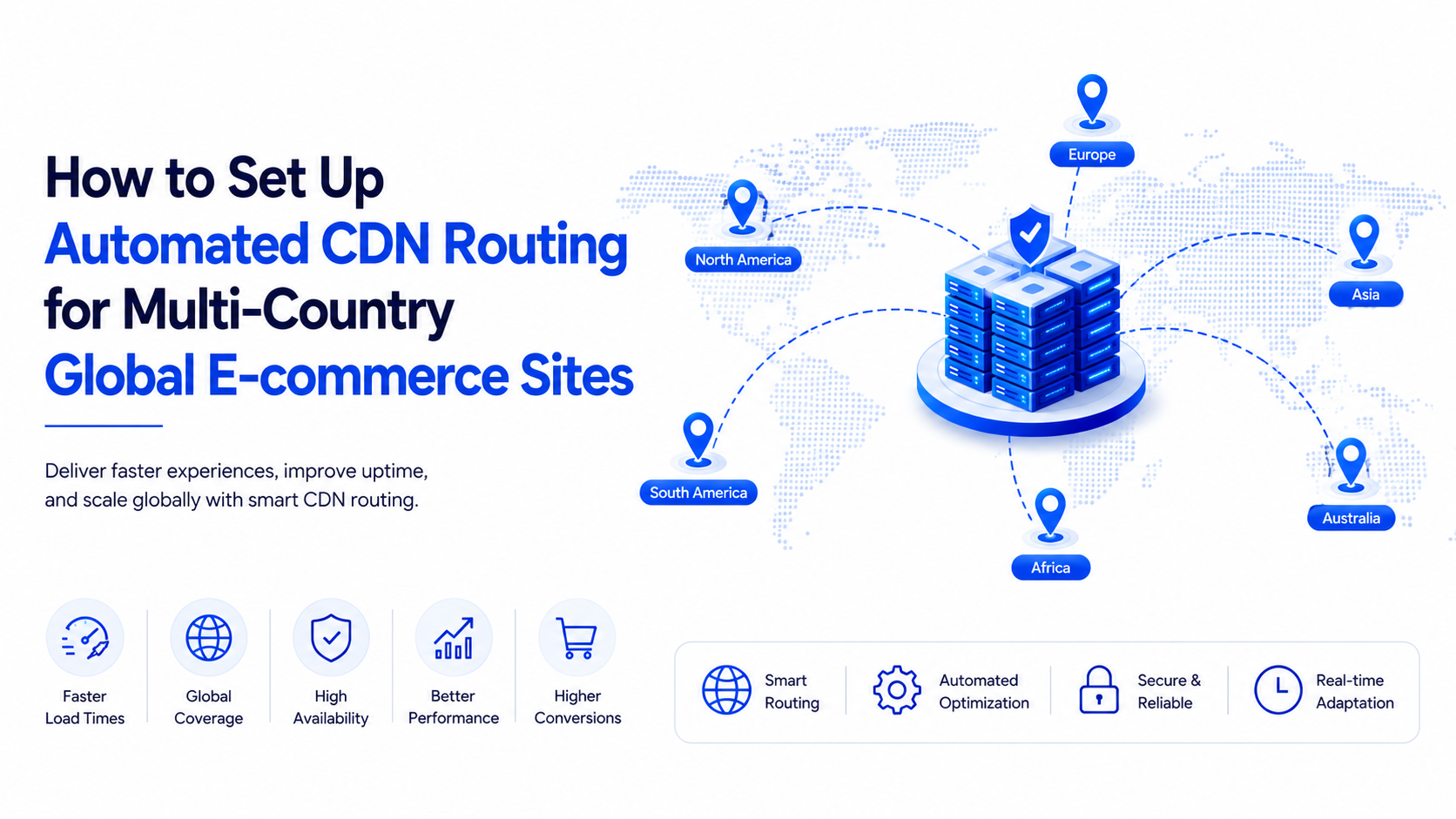
Automated CDN Routing: 7 Proven Ways to Master E-commerce Speed

If you are scaling an e-commerce brand across borders, you already know the harsh reality: latency kills conversions.
When a shopper in London tries to load a storefront hosted on a server in Virginia, the physical distance dictates a delay. Add a customized dynamic shopping cart, a localized currency calculator, and a high-resolution product video, and that delay turns into a 4-second load time. In the hyper-competitive Western e-commerce landscape, a 4-second load time is a digital death sentence. Users bounce, cart abandonment spikes, and your performance marketing campaigns bleed budget because you are paying for traffic that never waits long enough to convert.
To build a truly global, high-profit enterprise, you cannot rely on a single origin server or a basic, legacy Content Delivery Network (CDN). You need to implement automated CDN routing powered by edge computing.
This guide will walk you through the exact 7 strategies, technical setups, and business impacts of deploying an automated CDN routing system that guarantees a localized, ultra-fast experience for every user, whether they are in Manhattan, Melbourne, or Manchester.
The Revenue Impact of Global Latency
Before diving into the architecture, we must frame this as a business growth imperative, not just an IT project.
In e-commerce, speed is revenue. Amazon famously calculated that a page load slowdown of just one second could cost them $1.6 billion in sales each year. For a mid-market or enterprise brand generating $10M–$50M annually, a 500-millisecond delay in international markets can bleed hundreds of thousands of dollars in lost conversions.
When you enter multi-country operations, you face distinct challenges that automated CDN routing solves:
- Variable Network Conditions: An ISP in Germany routes traffic differently than an ISP in Texas.
- Dynamic Content Heaviness: Carts, wishlists, user sessions, and localized pricing cannot be statically cached like a standard image.
- Micro-Outages: Single-vendor CDNs experience regional micro-outages. If your sole CDN drops packets in the UK during Black Friday, your sales drop to zero.
Proper automated CDN routing solves this by intelligently reading the user's location, device, and network health, and instantly routing their request to the fastest, most reliable edge node available across a network of multiple CDN providers.
What is Automated CDN Routing (and Multi-CDN)?
Automated CDN routing is the process of using intelligent DNS (Domain Name System) and edge computing to direct user traffic to the optimal server in real time.
Traditionally, companies used one CDN (like Cloudflare or Akamai). A Multi-CDN architecture utilizes two or more CDNs simultaneously (e.g., Fastly + AWS CloudFront + Cloudflare). An intelligent routing layer sits above them, acting as an air traffic controller.
How the "Air Traffic Controller" Makes Decisions
For every single HTTP request, the automated CDN routing protocol analyzes:
- Geolocation: Where is the user geographically?
- Real User Monitoring (RUM) Data: Which CDN is currently delivering the fastest Time to First Byte (TTFB) in that specific city?
- Network Health: Is one CDN experiencing a DDoS attack or routing degradation in Europe?
- Cost/Traffic Commitments: If performance is equal, which CDN costs less for this specific media type?
If CDN "A" is experiencing latency in London, the system instantly and invisibly routes UK users to CDN "B". The user experiences zero downtime and maximum speed.
Core Architecture: How It Actually Works
To achieve enterprise-grade multi-country speed, your automated CDN routing architecture will rely on three fundamental pillars.
1. Anycast DNS Routing
Anycast is a network routing methodology where multiple servers share the same IP address. When a user queries your e-commerce domain, the Anycast network routes the request to the topologically closest server.
Unlike Unicast (one IP = one server), Anycast ensures that a shopper in Sydney querying checkout.yourbrand.com connects to a Sydney edge node, while a shopper in Toronto connects to a Canadian node, all using the exact same DNS record.
2. Edge Computing (Serverless at the Edge)
Modern routing goes beyond just serving cached images. Using platforms like Cloudflare Workers or Fastly Compute@Edge, you execute backend code directly at the network edge, inches away from the user.
Instead of a request traveling back to your origin server in Ohio to determine a user's local currency, a JavaScript or WebAssembly worker at the edge intercepts the request, reads the user's IP, injects the correct currency (USD, GBP, AUD), and serves the page instantly.
3. Dynamic Multi-CDN Load Balancing
Using a Global Server Load Balancer (GSLB) or a dedicated multi-CDN platform (like IO River, NS1 Pulsar, or EdgeNext), your traffic is dynamically segmented.
| Feature | Single CDN | Multi-CDN with Automated Routing |
|---|---|---|
| Uptime Guarantee | ~99.9% (Subject to vendor outages) | 100% (Instant failover to backup CDNs) |
| Global Coverage | Strong in home markets, weak in emerging | Optimized globally by combining vendor strengths |
| Dynamic Workloads | Routes back to central origin | Handled at the edge via Workers/Lambda |
| Cost Control | Locked into vendor bandwidth pricing | Traffic routed based on real-time cost arbitrage |
Setting Up Your Automated CDN Routing Architecture
Implementing this requires precision. Here is the 7-step blueprint for configuring an automated, multi-region CDN setup for an e-commerce platform (such as Shopify Plus, Adobe Commerce/Magento, or a headless Composable Commerce stack).
- Establish Your Origin Infrastructure and DNS Foundation: Do not change live DNS records yet. Before adding CDNs, ensure your origin servers are highly available. Implement a premium DNS provider that supports advanced traffic steering and RUM (Real User Monitoring). Set your origin Time To Live (TTL) very low (e.g., 60 seconds) so you can rollback quickly if needed.
- Select and Provision Your CDNs: Choose at least two CDNs with complementary strengths. For example, use Fastly for its ultra-fast invalidation of dynamic e-commerce catalogs, and Cloudflare for its massive global presence and robust WAF.
- Configure Edge Computing for Dynamic Content: Write and deploy edge scripts to handle carts and local pricing. Configure the worker to intercept requests and read the cf.country or Accept-Language headers.
- Define Your Automated CDN Routing Policies: In your smart DNS or multi-CDN control plane, set up your decision matrix based on Geolocation Rules, Performance Rules (RUM), and Failover Rules.
- Synchronize Cache Invalidation: When a product goes out of stock, it must reflect instantly worldwide to prevent overselling. You must build an API middleware layer to simultaneously fire API purge requests to both CDNs.
- Cutover and Test via Synthetic Monitoring: Update your primary domain's CNAME records to point to your smart router. Use synthetic testing tools to simulate checkouts from 20 different global cities simultaneously.
SEO Implications: Multi-Region Routing and Googlebot
A poorly executed automated CDN routing strategy will destroy your international SEO. Googlebot crawls from specific locations (primarily the US). If your edge router forces Googlebot into a geo-loop or serves the wrong localized content, your international rankings will plummet.
Subdirectories vs. ccTLDs at the Edge
For international SEO, you are likely using either ccTLDs (brand.co.uk, brand.com.au) or subdirectories (brand.com/uk/, brand.com/au/).
Your edge setup handles subdirectories brilliantly using Edge Rewrites.
When a user from Sydney types brand.com, your Edge Worker detects the Australian IP. Instead of issuing a slow 301/302 HTTP redirect (which causes a visible delay and dilutes link equity), the Worker invisibly rewrites the request on the server side to pull from the /au/ directory, while keeping the user on brand.com or cleanly moving them to the localized URL structure in milliseconds.
The hreflang Edge Strategy
hreflang tags tell Google which version of a page is meant for which region. Traditionally, developers hardcode these into the HTML <head>.
In a modern setup, you can use Edge Workers to inject hreflang tags dynamically into the HTTP headers rather than the HTML body. This reduces the HTML payload size (speeding up parsing) and allows your marketing team to update international SEO targeting via a central edge database without touching the origin codebase.
Critical SEO Warning: Never block users (or bots) from accessing other regional versions. Always base automatic geo-routing on the first visit, but set a localization cookie if the user manually changes regions, and program your edge workers to respect that cookie over their physical IP address.
Security, Privacy, and Compliance at the Edge
Operating in Western markets means navigating a minefield of data privacy regulations: GDPR in the UK/Europe, CCPA in California, and strict PCI-DSS requirements for payment data.
Automated edge routing enhances compliance by allowing you to enforce data sovereignty geographically.
- Geo-Fencing: You can configure your multi-CDN router to drop traffic from embargoed countries at the DNS level, meaning malicious traffic never even reaches your WAF, saving you bandwidth costs.
- Edge Data Localization: Under GDPR, transferring EU citizen data to US servers can be legally complex. You can write an edge function that detects an EU user, processes their analytics and non-PCI data locally in a Frankfurt edge node, and scrubs Personally Identifiable Information (PII) before syncing the anonymized data back to your central US database.
- DDoS Mitigation: By distributing your traffic across multiple CDNs, you vastly increase your overall network capacity. A volumetric DDoS attack that might overwhelm a single CDN provider will be absorbed and mitigated when spread across the infrastructure of Fastly, Cloudflare, and AWS combined.
Execution and Scalability: The Agency Perspective
From a business consulting perspective, transitioning to an automated CDN routing architecture is not a cost center—it is a conversion rate optimization (CRO) investment.
When you scale your e-commerce operations, the goal is predictable lead generation, recurring revenue, and airtight profitability.
- Automation: By removing manual DNS switching and relying on RUM-based automated CDN routing, your DevOps team saves hundreds of hours in incident response.
- Scalability: You can launch a new market in Germany tomorrow. Your infrastructure doesn't change; you simply activate European edge nodes and update your routing rules.
- Profitability: By utilizing cost-based routing (sending heavy video traffic to cheaper CDNs while keeping dynamic cart queries on premium, ultra-fast CDNs), you actively drive down your cloud infrastructure bills.
Conclusion: Future-Proofing Your Global E-commerce Stack
In the high-stakes arena of global e-commerce, the physical distance between your servers and your customers should never dictate your revenue limits. An automated CDN routing architecture powered by edge computing is no longer a luxury reserved for tech giants—it is a foundational requirement for any ambitious brand scaling across Western markets.
By moving logic to the edge, intelligently routing traffic based on real-time user data, and embracing a dynamic multi-vendor CDN strategy, you eliminate the single points of failure that cause cart abandonment. You are not just paying for faster page loads; you are investing in higher conversion rates, lowered customer acquisition costs, and airtight international SEO stability.
The Final Takeaway: Do not wait for a peak shopping event like Black Friday to expose the cracks in your legacy infrastructure. Start the transition today. Audit your global latency, deploy your first edge worker, and if you need expert implementation, consult with our technical growth team to build a digital storefront that delivers a premium, zero-latency experience to every single customer.