
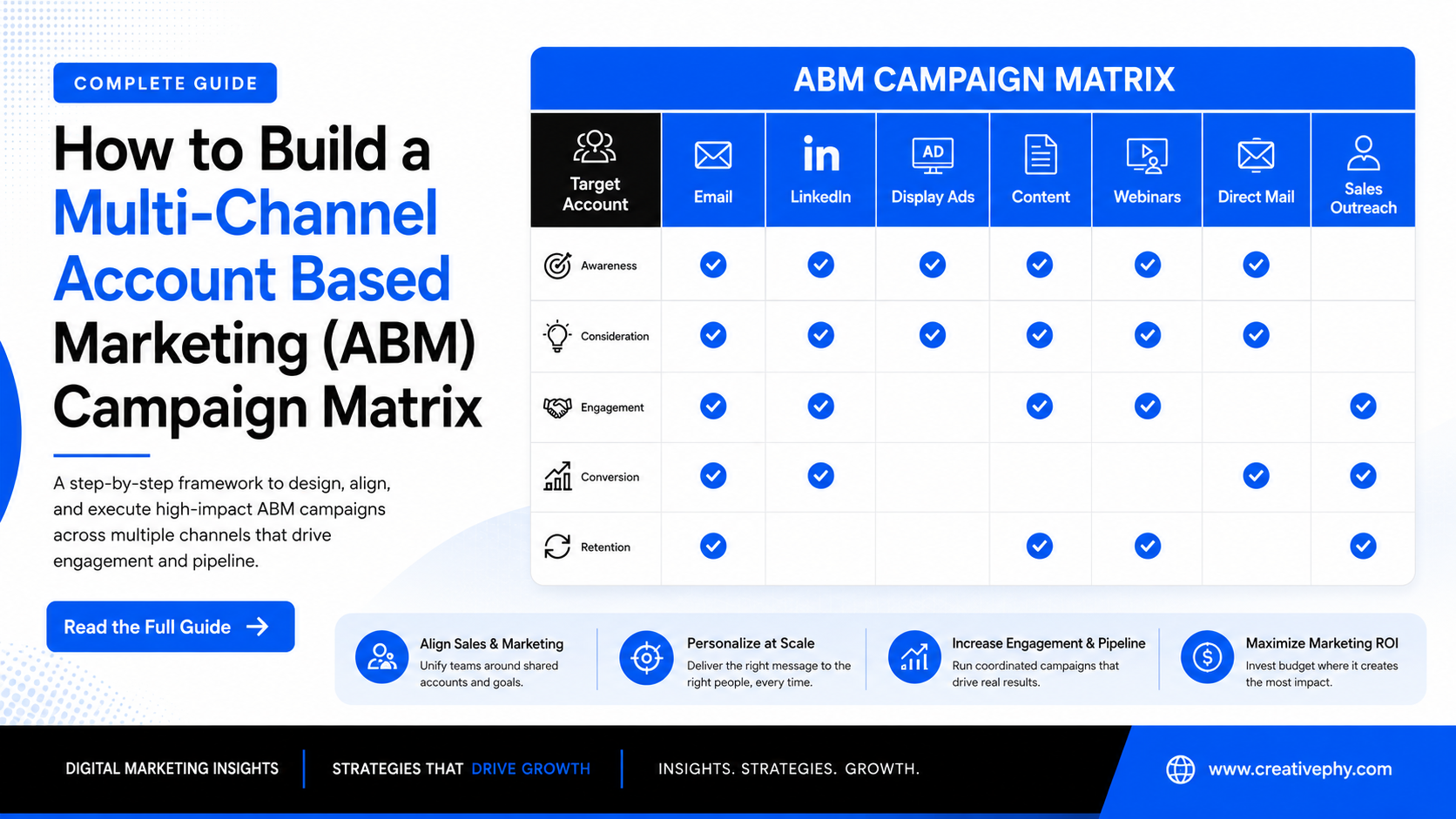
ABM Campaign Matrix: 5 Powerful Steps to Win Enterprise Accounts
A master engineering architecture blueprint engineered to align executive buying committees, synchronize marketing channels, and capture high-value enterprise accounts.
Winning enterprise customers has become more challenging than ever. Modern B2B buyers no longer rely on a single touchpoint before making a purchase decision. Instead, they interact with brands across multiple digital channels, compare vendors extensively, consume educational content, attend webinars, engage on LinkedIn, read customer reviews, and often involve several stakeholders before choosing a solution.
This shift has made traditional lead generation strategies less effective, especially for businesses targeting high-value accounts. As a result, Account Based Marketing (ABM) has emerged as one of the most successful B2B marketing strategies for companies looking to generate qualified pipeline, shorten sales cycles, and improve revenue efficiency.
However, running ABM campaigns on a single channel is no longer enough. Today's successful B2B organizations combine email marketing, LinkedIn outreach, paid advertising, website personalization, webinars, content marketing, CRM automation, and sales engagement into one coordinated strategy. This is where a Multi-Channel ABM Campaign Matrix becomes essential.
The Multi-Channel Blueprint
A campaign matrix helps marketing and sales teams organize every interaction with target accounts. Instead of random campaigns, every touchpoint follows a planned sequence designed to educate, engage, and convert decision-makers. In this comprehensive guide, you'll learn how to build a scalable multi-channel framework that generates predictable revenue growth.
What Is a Multi-Channel ABM Campaign Matrix?
A Multi-Channel Account Based Marketing Campaign Matrix is a strategic framework that maps every marketing and sales activity across different channels for a specific group of target accounts. Instead of treating each marketing campaign separately, the matrix coordinates target accounts, buyer personas, buying stages, marketing channels, sales outreach, content assets, messaging, KPIs, campaign timing, and team ownership.
Think of it as the master blueprint for your ABM strategy. Rather than asking: "What email should we send?" your team begins asking: "What experience should this account receive across every channel during the buying journey?" That simple mindset shift creates significantly better customer experiences.

The Core ABM Campaign Matrix Blueprint
| Target Account | Persona Target | Buying Stage | Channel | Asset Concept | CTA Execution | Primary KPI |
|---|---|---|---|---|---|---|
| Tier-1 Enterprise SaaS | Chief Marketing Officer | Awareness | LinkedIn Account Ads | Proprietary Industry Report | Download Blueprint | CTR (1.8%) |
| Tier-1 Enterprise SaaS | Marketing Director | Consideration | Hyper-Personalized Email | Bespoke Case Study Audit | Secure Strategy Call | Reply Rate (12%) |
| Tier-1 Enterprise SaaS | CEO / CFO Execs | Decision | Direct Account Outreach | Custom ROI Calculator Model | Schedule Platform Demo | SQL Conversion |
Why Multi-Channel ABM Outperforms Traditional Marketing
Traditional demand generation focuses on generating as many leads as possible. ABM focuses on winning the right accounts. Instead of attracting thousands of anonymous visitors, you identify companies that perfectly match your Ideal Customer Profile (ICP) and build personalized experiences specifically for them.
A multi-channel approach improves this process because different decision-makers consume information differently. A coordinated framework ensures each stakeholder receives the technical documentation or financial justification they need at the right time.
Learn more about B2B optimization on high-authority resources like HubSpot B2B Academy or check professional networking frameworks via LinkedIn Marketing Solutions.
Committee Personalization Engine
Core Components of an ABM Campaign Matrix
Every successful campaign matrix configuration relies on deep alignment between personalization mechanics and data architecture. First, you must explicitly lock down your Ideal Customer Profile (ICP), filtering fields across target industries, employee metrics, corporate revenue run-rates, and geographical regions.
Once the ICP is verified, you transition directly to structural prioritization by segmenting your central targets into three separate, highly focused tiers:
Tier 1 Accounts
High-value enterprise profiles requiring manual, account-specific personalization pipelines.
- Bespoke Landing Hubs
- Custom Executive Videos
- Deep Tailored Proposals
Tier 2 Accounts
Semi-personalized target blocks clustered by explicit industry verticals or tech stacks.
- Vertically Tailored Plays
- Targeted Explicit Webinars
- Shared Matrix Assets
Tier 3 Accounts
Highly programmatic automated campaigns optimized for broad market scale.
- Structured Automated Nurture
- Programmatic Ad Insertion
- Scale Intent Retargeting
Designing and Optimizing Your ABM Campaign Matrix
To maximize your multi-channel deployment performance metrics, you need to map content assets systematically against the entire buyer's journey lifecycle. If target leads are stuck in the consideration layer, passing generic top-of-funnel blog links will cause massive drop-offs. Instead, serve highly complex verification modules like comparison sheets, interactive architectural demos, or explicit performance matrices.
Macro Industry Reports & Insight Whitepapers
Targeted Execution Guides & Strategy Audits
Granular B2B Client Case Validation
Interactive Custom ROI Calculator Dashboards
Executive Customer Advisory Boards
Always ensure complete synchronization across every channels. Whether a prospect interacts with your growth modules via customized automated workflow sequences or directly inside targeted social ecosystems, they should receive identical core narratives, unified unique selling propositions, and clear, distraction-free transactional calls-to-action.
Campaign Launch Validation Matrix
Confirm operational ready status across core multi-channel pipelines before live execution.