
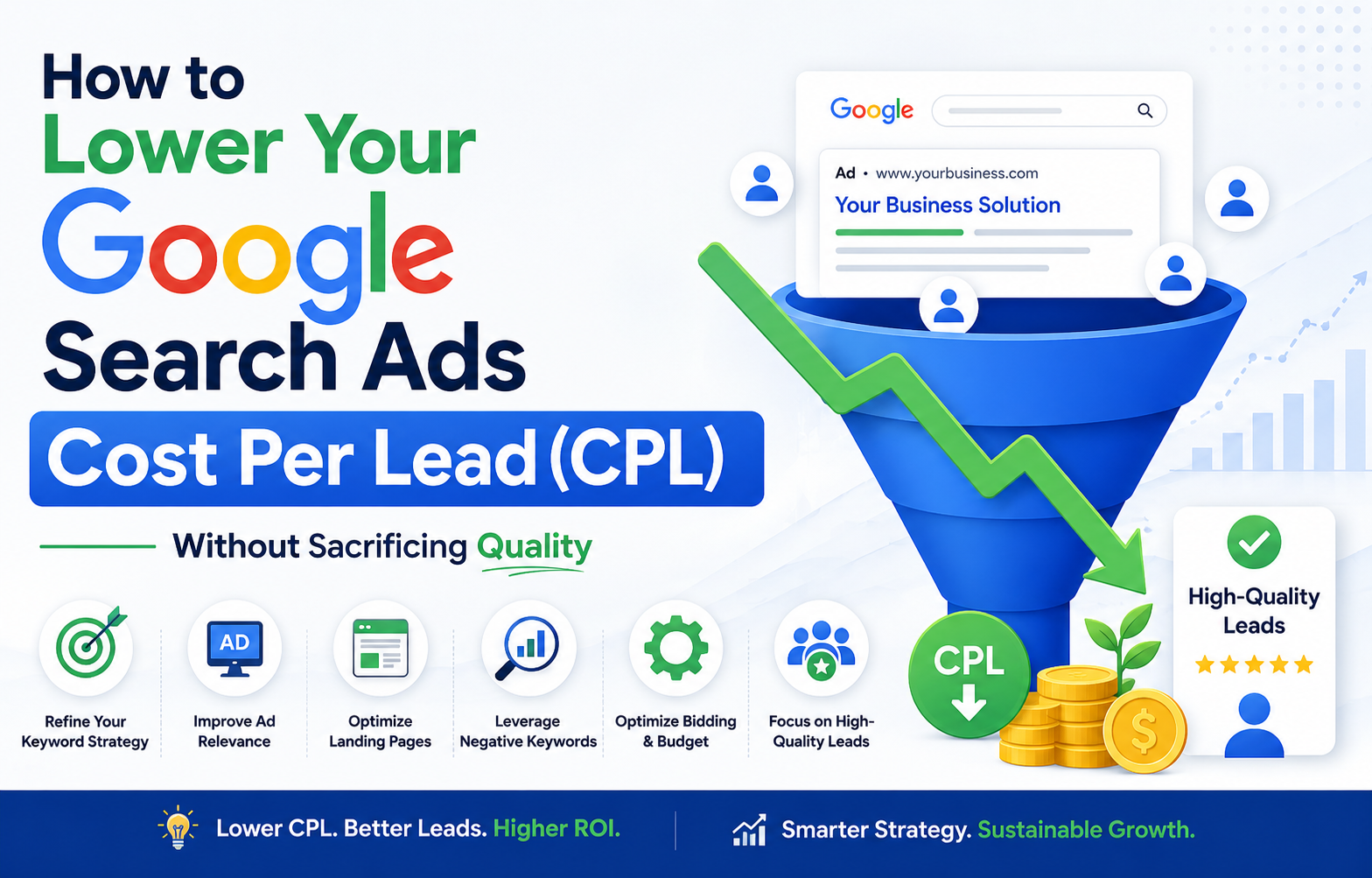
How to Lower Your Google Search Ads Cost Per Lead (CPL) Without Sacrificing Quality

In the competitive ecosystem of digital marketing, learning How to Lower Your Google Search Ads Cost Per Lead (CPL) Without Sacrificing Quality is the ultimate blueprint for sustainable business scaling. Many performance marketers make the costly mistake of cutting their budgets or slashing keyword bids blindly. This reactionary approach results in low-intent traffic, spam form entries, and generic leads that drain your pipeline.
In high-paying Tier-1 global markets like the USA, UK, Germany, Australia, and Japan, digital clicks can range from $10 to well over $100 in competitive industries such as B2B SaaS, Legal Services, Real Estate, and Financial Solutions. To maximize conversion volume while keeping margins high, growth-focused businesses rely on programmatic structure rather than guesswork.
This master guide breaks down the data-driven systems top-tier digital media firms utilize. By deploying these systems, you will discover exactly how to lower your Google Search Ads cost per lead (CPL) without sacrificing quality, ensuring your client acquisition strategy remains highly predictable and profitable.
- 1. How to Lower Your Google Search Ads Cost Per Lead (CPL) Without Sacrificing Quality via Quality Score Optimization
- 2. Dynamic Negative Keyword Mapping Protocols
- 3. High-Converting Multi-Step Funnel Architectures
- 4. Value-Based Bidding & First-Party Data Feeds
- 5. Full Performance & Core Readability Checklist
1. How to Lower Your Google Search Ads Cost Per Lead (CPL) Without Sacrificing Quality via Quality Score Optimization
To master the process of how to lower your Google Search Ads cost per lead (CPL) without sacrificing quality, you must first manipulate Google's live auction pricing mechanics. Google calculates ad rank using a strict algorithmic formula:
Your actual billing rate per click is determined by taking your immediate competitor’s structural positioning and dividing it by your optimization score:
This system shows why Quality Score engineering is your highest ROI tool. When analyzing how to lower your Google Search Ads cost per lead (CPL) without sacrificing quality, moving your scores from a basic 5/10 up to a premium 8/10 can decrease your effective CPC by up to 50%. This structural drop means your total lead tracking volumes double for the exact same marketing overhead.
Execution Steps for Quality Score Maximums
- Deploy Single Theme Ad Groups (STAGs): Organize your account cleanly into STAGs. Keep your primary target text, ad copies, main headlines, and landing page header structures contextually aligned.
- Increase Expected Click-Through Rates (CTR): Use Dynamic Keyword Insertion (DKI) assets coupled with rich extension components (sitelinks, callout snippets, structured tags, and active lead forms) to capture optimal mobile and desktop real estate. Read more details on the official Google Ads Support Network.
- Refine Landing Page Experience: Keep mobile page loading speeds under 2.0 seconds. Your landing page layout must directly satisfy the promise made in your search copy without creating programmatic friction.

2. Dynamic Negative Keyword Mapping Protocols
Paying premium rates for low-intent clicks is a fast track to inflated CPL metrics. When tracking the blueprint of how to lower your Google Search Ads cost per lead (CPL) without sacrificing quality, omitting persistent monitoring of your Search Terms Report forces broad and phrase match keyword parameters to inevitably match with unoptimized informational search queries.
To establish clean account tracking, construct an agency-grade multi-tiered negative exclusion matrix before turning your live campaigns on. This structure keeps your incoming lead flow targeted:
| Category | High-Risk Negative Keywords to Exclude |
|---|---|
| Low Intent / Research | "free", "cheap", "pdf", "book", "course", "template", "salary", "jobs" |
| Competitor Inquiries | Names of competing software platforms, applications, or rival brands |
| Informational Queries | “what is”, “how does”, “history of”, “define”, "exemplar" |
Pro Tip: Evaluate live search terms every 48 hours for the first two weeks of launch. Block informational strings entirely by turning them into exact-match negatives. For continuous growth and high-converting marketing frameworks, explore our setup tutorials at Creativephy.
3. High-Converting Multi-Step Funnel Architectures
Traditional landing pages pose a major dilemma for advertisers attempting to crack how to lower your Google Search Ads cost per lead (CPL) without sacrificing quality: hyper-short forms generate low CPLs but introduce low-quality leads, whereas extended long forms create immense friction, causing valid prospects to bounce.
Premium brands break this deadlock by transitioning to conditional-logic multi-step interactive flows:
By engaging users through structured micro-commitments (asking about specific marketing timelines, operational sizes, or key pain points first), you ease the psychological barrier to conversion. Prospects who complete 2-3 qualification questions are 80% more likely to provide genuine phone numbers and accurate business emails at the final gate.
Additionally, passing entries through real-time API filters blocks fake email providers and invalid mobile numbers before your sales team ever receives them.
4. Value-Based Bidding & First-Party Data Feeds
Google’s automated smart bidding systems are highly robust, but they depend heavily on the quality of data they receive. If your goal is to discover how to lower your Google Search Ads cost per lead (CPL) without sacrificing quality, scaling a Maximize Conversions strategy purely on surface-level website pixel hits forces the machine learning system to find the cheapest, lowest-intent users available.
Implementing the Advanced Data Loop
- Activate Google Enhanced Conversions: Route secure, hashed first-party user data back into your ad dashboard. This tracks exactly who your genuine buyers are in premium markets.
- Deploy Value-Based Bidding (VBB): Assign specific financial weights to unique conversions. Pass a baseline $10 valuation for newsletter downloads versus a premium $150 tracking value for verified sales discovery calls. This forces the bidding system to optimize for high-value pipelines.
5. Full Performance & Core Readability Checklist
- Bi-Weekly Keyword Cleanups: Audit your search terms regularly. Flag any phrases scoring under 7/10 for immediate restructuring.
- Strategic Match Type Control: Use exact-match modifiers to maintain tight cost control. Reserve broad match until you have a rich negative history and solid first-party data signals.
- Technical Speed Audits: Keep mobile page scores above 90 on Google PageSpeed Insights to minimize bounce rates.
- Offline Conversion Tracking: Import CRM sales milestones back into Google Ads to align the bidding engine with actual revenue rather than vanity metrics.
Conclusion: Cost and Quality Balance for Sustainable Growth
The final solution for How to Lower Your Google Search Ads Cost Per Lead (CPL) Without Sacrificing Quality requires improving your conversion ecosystem, not lowering your bids. Outbidding enterprise players in expensive Tier-1 markets is a losing strategy. The advertisers who succeed are the ones who build high-converting user journeys. Deploy these data-driven strategies, optimize your feedback loops, and watch your margins scale efficiently month-over-month.