
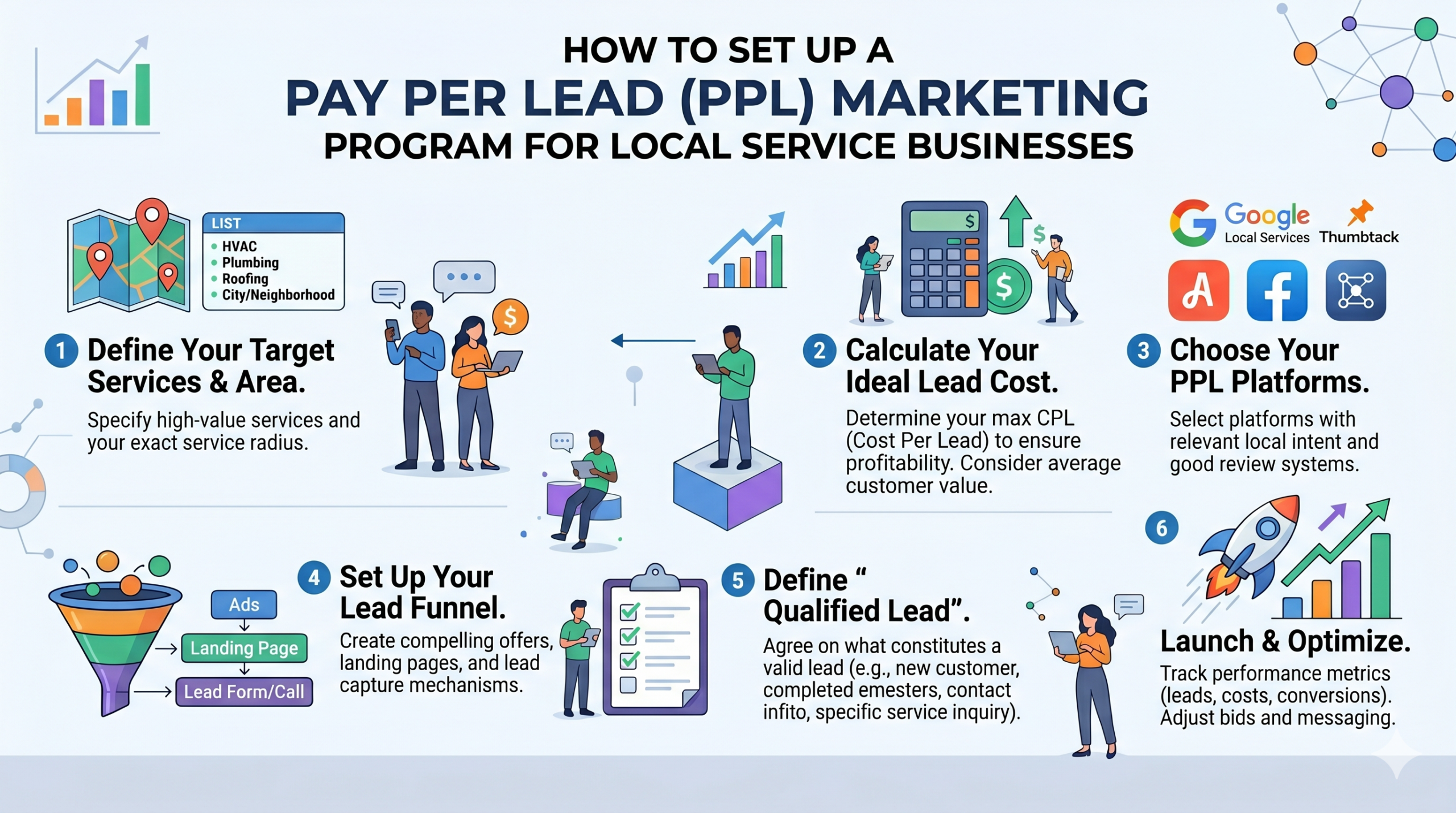
How to Build a Pay Per Lead Marketing Program in 6 Steps for Local Service Businesses
If you’re a local service business – perhaps you’re a commercial plumbing company, an elite roofing team or a high-ticket HVAC outfit – you’ve probably grown tired of paying monstrous monthly retainers to traditional digital marketing agencies with vague promises like “brand awareness” or “clicks.”

Clicks don’t pay the bills in a competitive local market. Conversions do.
And that’s exactly why high-growth local service firms are rapidly moving toward a performance-based asset. By developing a structured Pay Per Lead marketing program you can transfer all the financial risk from your operational budget to your marketing infrastructure. You stop paying for empty digital impressions and only pay when a high-intent, highly qualified lead actually calls your business.
This detailed guide will walk through exactly how to build, launch and optimize a high-ROI performance marketing ecosystem from scratch.
What is Pay Per Lead Marketing (PPL) Framework?
Before we go into operational setup, let’s get a crystal clear definition.
A corporate Pay Per Lead marketing setup is a customer acquisition model of paying marketers a pre-determined amount of money to generate qualified leads for a business. The business only pays for the leads that actually put their hand up and ask for a service.
This model is different from the traditional advertisement models, where you pay upfront to get ad placements (billboards, traditional Google impression bids). Here, your marketing spend is directly proportional to actual revenue generating opportunities.
Step 1: Define a “Qualified Lead” (The Foundation)
The number one reason performance Pay Per Lead marketing partnerships fail is that there is no agreement on what constitutes a billable asset. If your definitions are fuzzy, you'll find yourself battling over spam calls, wrong numbers, and out-of-market pitches.
For seamless programming, set your parameters ahead of time:
- Exclusive vs Shared: Shared leads (think of leads sold on HomeAdvisor or Angie’s List) are sent out to 4–5 competitors at the same time, making acquisition a race to the bottom on price. If you are a premium service business, your program needs to be 100% exclusive leads, period.
- Intent Parameters: Minimum duration constraint on a billable inbound phone call (e.g. any call that lasts longer than 60 seconds and where a prospect asks about your core service).
- Geographic Limits: Please list the zip codes, counties or radius that your working crews service. Any lead that is outside of this boundary is marked as non-billable.
Step 2: Create the High Converting Digital Capture Engine
You cannot expect a high conversion rate if you drive performance traffic to a generic, cluttered corporate homepage. You need an isolated, hyper-focused conversion asset to maximize your return.
1. Psychology of the landing page
Your landing page should be designed with a single objective in mind: prompting a phone call or a detailed form submission. Remove main navigation menus, social media links, and footer links that take users off the page.
2. Structure and visual hierarchy
- Above the Fold: Your unique value proposition (in bold), list of three immediate benefits (i.e. "24/7 Emergency Service, 5-Star Rated, Upfront Pricing") and an omnipresent click-to-call phone number.
- Social Proof and Authority: Show real-time Google reviews, local trust badges and before-after photos of your actual work for instant trust.
Step 3: Design the Traffic Acquisition Framework
And if you want to drive consistent, high-intent inquiries for your systematic Pay Per Lead marketing system, you must leverage search channels where users are searching for immediate local solutions.
1. Google Local Service Ads (LSA)
Google LSAs are the very top of the search engine results page (SERP). They show your Google Screened or Google Guaranteed badge, your star rating and your business phone number. The best part? Here Google is inherently a per lead charge and is a perfect fit for this operational model. You can learn more about premium configurations via Google Ads Core Console.
2. Intent Based Google Search Ads
Focus on high-intent transactional long tail keywords, not broad informational keywords. For example, bidding on “emergency AC repair near me” or “commercial pipe bursting specialist” will convert at a much higher rate than bidding on broad terms like “air conditioning tips.”
Step 4: Bullet-Proof Lead Tracking and Attribution
To run a successful performance program, you need to have the right data tracking infrastructure in place. You cannot optimize what you cannot measure properly.
Call Tracking Metrics reviews
Use a dedicated call tracking platform like CallRail Enterprise Systems or CallTrackingMetrics Automation. The software automatically attaches tracking numbers to your landing pages so you can trace each inbound phone call back to the keyword, ad creative and campaign that drove it.
Also, switch on call recording. You can listen to these calls to audit lead quality and make sure your intake or dispatch team is doing a good job working these high-intent opportunities.
Form & Form to Call Automations
Every minute you wait to respond to a quote request form from a prospect, your close rate is reduced exponentially. Use tools like Zapier Webhooks to build out automation sequences that will SMS your sales team or fire off an automated outbound callback the instant a form is submitted.
Step 5: Determine the Unit Economics and Pricing Model
What should you really pay – or charge – for a qualified lead? Pricing correctly requires a close look at your key business metrics.
| Service Vertical | Average CPL Range | Target Closing Rate | Customer Lifetime Value (LTV) |
|---|---|---|---|
| Home Plumbing | ₹3,500 – ₹7,000 | 35% | ₹25,000+ |
| Replacement Roofing | ₹12,000 – ₹25,000 | 20% | ₹3,500,000+ |
| HVAC Installation | ₹6,000 – ₹12,000 | 30% | ₹6,000,000+ |
| Water Damage Restoration | ₹20,000 – ₹45,000 | 45% | ₹4,500,000+ |
To find your perfect maximum Cost Per Lead, use this formula:
When you spend 25% of your gross profit from a job on customer acquisition, you have healthy margins and a highly profitable business.
Step 6: Develop, Automate and Protect Your Program
If you have steady converting channels for initial traffic, seek opportunities to scale your program in a sustainable manner:
- Negative Keyword Scrubbing: Check search terms weekly. Add negative keywords for terms such as "cheap," "free," or "jobs" to avoid wasting ad spend on low-intent searchers.
- Smart Bidding Algorithms: When your pixel is tracking 30-50+ conversions a month, change your Google Ads plan to Target CPA (Cost Per Acquisition) so machine learning can automatically optimize your lead flow.
- Lead Dispute Procedure: Create a simple, systematic process for reviewing your monthly lead log. This helps you to quickly weed out and dispute automated spam, robo-calls or duplicates so you only pay for real opportunities.
Develop a systematic, data-backed approach to your customer acquisition and replace unpredictable marketing results with a steady, reliable stream of inbound business.