
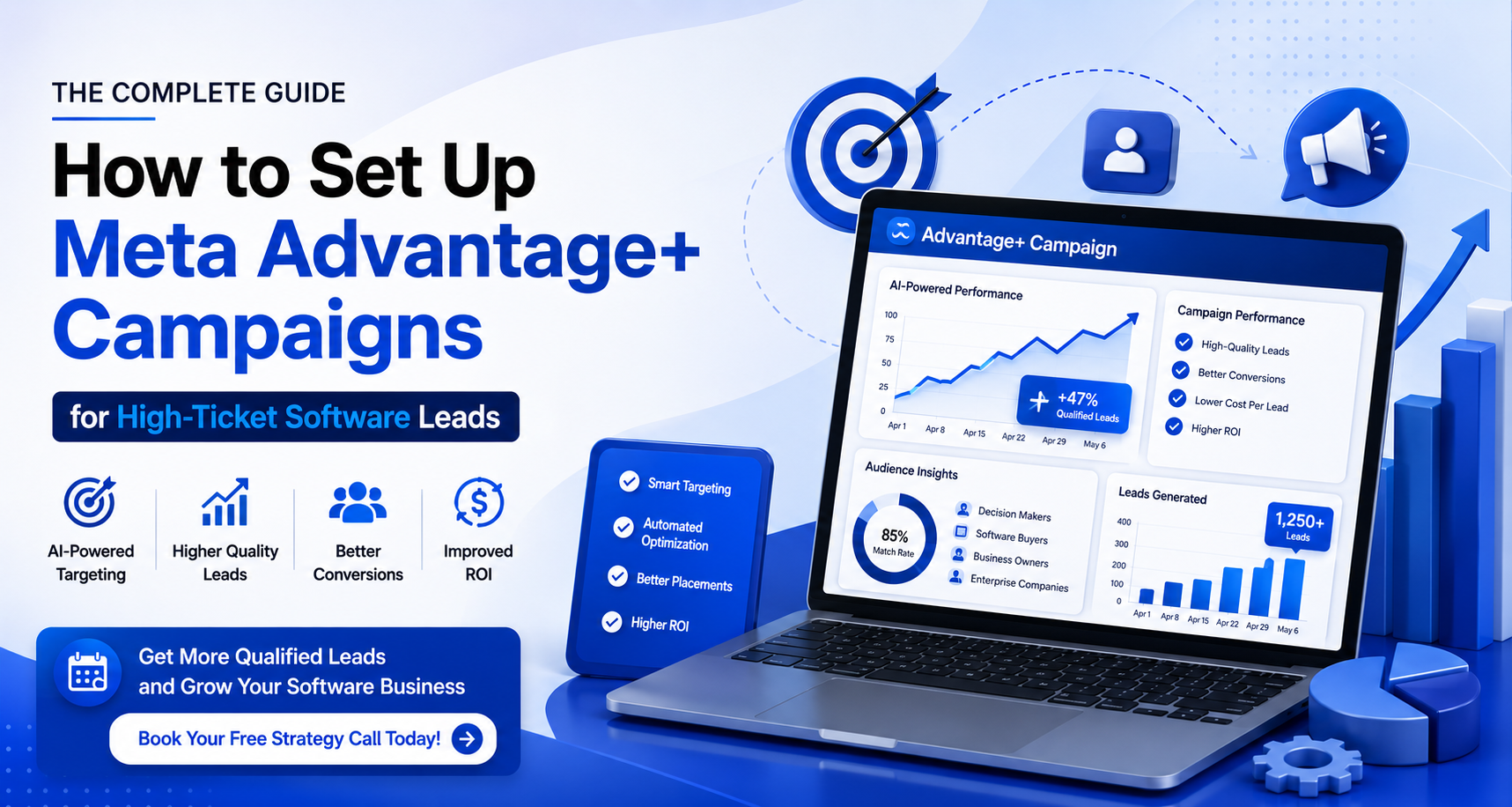
How to Set Up Meta Advantage+ Software Leads Funnels for High-Ticket B2B Contracts
The definitive 2026 playbook to consistently capturing and converting enterprise-level decision-makers using AI-driven performance marketing.
⚡ Executive Summary
Scaling enterprise software sales requires absolute precision. Generating optimized Meta Advantage+ software leads eliminates manual overhead by using predictive machine learning to pinpoint target buyers in high-value global markets.
Enterprise-level software sales have reached peak saturation. Whether your ecosystem deals in massive CRM deployments, mission-critical cybersecurity suites, full-scale ERP frameworks, niche AI tools, HR infrastructure, or global cloud management, the standard digital marketing strategy is falling short. Buyers are smarter, data is fragmented, and classical manual ad testing drains budgets before building any real pipeline momentum.
This is why leading global brands have transitioned completely to target-driven pipelines built to acquire Meta Advantage+ software leads. By passing the heavy operational lifting over to Meta's deep neural networks, software companies can easily lower customer acquisition costs while injecting predictable, sales-qualified leads straight into their pipeline.
Decoding Meta Advantage+ Software Leads Architecture
At its core, Meta Advantage+ is an automation-first engine. Instead of manual ad sets where you micro-manage granular demographics, the AI actively scans millions of active profile behaviors, tracking data nodes to locate actual enterprise buyers.
Finds critical buyers your manual tracking configurations completely miss.
Automatically shifts performance capital directly to high-converting variants.
Why High-Ticket Tech Demands an AI Setup
High-ticket software is never an impulse buy. Enterprise deal sizes worth thousands of dollars require deep validation across multiple stages: Problem Identification, Core Feature Comparison, Stakeholder Procurement Reviews, and Live Product Demos.
By building robust campaigns scaled to generate Meta Advantage+ software leads, your system feeds on conversion signals. To master how algorithmic distribution engines optimize system parameters, review the architectural blueprints on the official Meta Business Help Engine. The deeper the data you send the engine, the faster it learns how to pattern-match and capture high-intent accounts across premium markets like the US, Canada, UK, and Europe.
A Step-by-Step Blueprint to Scaled Operations
1. Target High-Intent Conversion Events Only
Stop optimizing for general page traffic or post engagement. If you want executive clients, train your pixel exclusively on high-value end goals like Demo Requests, Custom Validations, or Scheduled Consultations.
2. Build an Unbroken Tracking Pipeline
Deploy both the native Meta Pixel and Conversions API (CAPI) side-by-side. Connect your CRM system directly to post down-funnel lifecycle changes (like SQL status or Deals Won) back to the ad manager.
3. Design High-Context Landing Pages
Enterprise executives don't convert on messy websites. Keep your landing page completely focused on a single business outcome. If you require expert scaling blueprints, evaluate our deep deployment strategies on the Creativephy Marketing Services Portfolio.
4. Leverage Advantage+ Broad Target Controls
Instead of choking the algorithm with tight interest groups, supply it with open 'Audience Hints'—such as target sectors (SaaS, Healthcare, Logistics) and decision-maker seniority levels—and let the machine expand your reach.
5. Diversify Creative and Formats
Give the system an expansive creative arsenal: concise interface deep dives (30–60s product run-throughs), technical carousels showcasing complex app native-integrations, and impact static images highlighting measurable ROI metrics.
6. Write Outcome-Focused Ad Copy
Ditch product feature jargon; emphasize immediate bottom-line business value. Use action-driven hooks like: "Automate Your Enterprise Resource Workflows Faster" or "Minimize Multi-Cloud Tool Overlap Costs Immediately".
7. Activate Ubiquitous Automated Placements
Do not cherry-pick specific channels manually. Allow Meta to efficiently deliver your campaign across all available feeds, stories, reels, and associated partner channels where decision-makers actively browse.
8. Implement Downstream Lead Scoring
Optimize your pipeline based on quality rather than sheer volume. Sync qualified criteria milestones from your internal database so the ad engine learns how to aggressively disregard low-tier submissions.
9. Deploy a Strategic B2B Retargeting Funnel
Since high-ticket cycles take time, configure secondary touchpoints for users who downloaded documentation, reviewed core system pricing, or watched specific product explainers.
10. Scale Budget Controls with Moderation
Keep the system from throwing errors by avoiding sudden price jumps. Scale budgets carefully by 15% to 20% every few days, keeping a sharp eye on critical indices like Cost Per Qualified Lead (CPQL).
Frequently Asked Questions
Are Meta Advantage+ campaigns effective for high-ticket software leads?
Absolutely. When paired with server-side CAPI tracking and accurate down-funnel scoring data, Advantage+ reliably identifies corporate decision-makers and improves lead quality over time.
What baseline budget works best for enterprise SaaS ads?
We recommend setting up a baseline daily budget between $100 and $300 USD. This provides enough data volume for the platform to quickly exit its learning phase.
Conclusion
Transitioning to AI-driven customer acquisition isn't just an option anymore—it's standard practice for modern B2B tech brands. By deploying Meta Advantage+ software leads pipelines alongside solid CRM feedback loops, your brand can consistently capture top enterprise contracts while maintaining complete efficiency.