
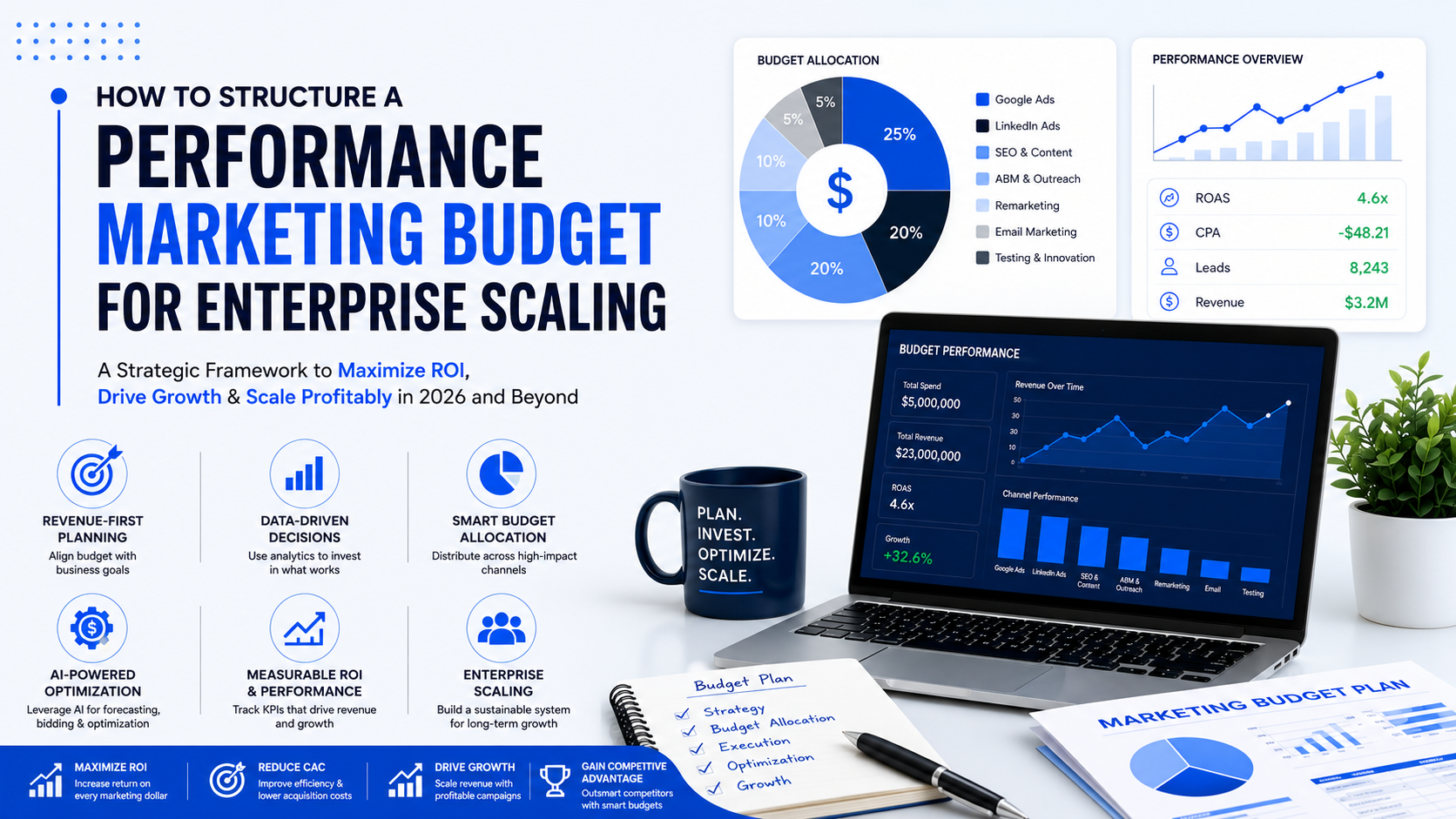
Performance Marketing Budget for Enterprise Scaling
Introduction
For enterprise organizations, marketing budgets are no longer simple spreadsheets filled with estimated advertising costs. In today's highly competitive digital economy, every dollar invested in marketing is expected to generate measurable business outcomes. Executive teams increasingly expect marketing departments to demonstrate accountability, predictable revenue growth, and scalable customer acquisition.
This shift has transformed the Performance Marketing Budget for Enterprise Scaling into one of the most critical components of a successful growth strategy.
Unlike traditional budgeting methods that allocate spending based on historical performance or fixed departmental percentages, modern performance marketing focuses on measurable results. Budgets are continuously optimized using data, automation, artificial intelligence, and attribution models to maximize return on investment while supporting sustainable business expansion.
As businesses scale across multiple markets, product lines, and customer segments, marketing leaders face increasingly complex decisions. They must determine how much to invest in paid search, social advertising, content marketing, account-based marketing, video campaigns, remarketing, and emerging AI-powered channels without sacrificing profitability.
A well-structured Performance Marketing Budget for Enterprise Scaling provides the flexibility to adapt to changing market conditions while maintaining consistent growth. Instead of reacting to short-term performance fluctuations, successful enterprises build dynamic budgeting systems that evolve with customer behavior, technological advancements, and competitive pressures.
This guide explores the frameworks, budgeting models, performance metrics, and future-ready strategies that enterprise organizations can use to maximize every marketing investment. To systematically ensure your primary web assets translate this target traffic efficiently, discover our advanced SEO Services frameworks.
Why Performance Marketing Budget for Enterprise Scaling Matters
Many organizations continue to treat budgeting as an annual finance exercise rather than a strategic growth initiative. This outdated approach creates several challenges.
Marketing teams often receive fixed budgets without considering evolving customer behavior, rising advertising costs, new acquisition channels, or changing market opportunities. As a result, campaigns become constrained by rigid spending limits rather than guided by business objectives. Industry analysis featured on the Think with Google platform confirms that rigid capital allocations are the primary bottleneck slowing down digital product adoption trends.
A strategic Performance Marketing Budget for Enterprise Scaling addresses these limitations by aligning marketing investments with measurable business outcomes. Instead of asking, "How much should we spend?" high-performing organizations ask, "Where will each additional dollar create the greatest incremental return?"
This shift in thinking enables companies to:
- Scale profitable campaigns faster
- Reduce wasted advertising spend
- Improve customer acquisition efficiency
- Increase marketing accountability
- Strengthen collaboration between marketing, sales, and finance
- Respond quickly to market changes
- Allocate resources based on real-time performance
For enterprise businesses operating in competitive industries, these advantages can significantly influence long-term profitability. Partnering with a dedicated agency can streamline this integration; explore how our comprehensive B2B Lead Generation programs drive predictable corporate growth.
Understanding Enterprise Performance Marketing
Performance marketing is a data-driven approach in which advertising investments are directly tied to measurable outcomes. Rather than focusing solely on impressions or brand awareness, performance marketing prioritizes metrics such as:
- Qualified Leads
- Marketing Qualified Leads (MQLs)
- Sales Qualified Leads (SQLs)
- Pipeline Growth
- Customer Acquisition Cost (CAC)
- Return on Ad Spend (ROAS)
- Customer Lifetime Value (CLV)
- Revenue Generated
- Conversion Rate
- Incremental Revenue
This accountability makes a functional Performance Marketing Budget for Enterprise Scaling fundamentally different from traditional marketing planning. Every campaign should contribute to measurable business growth.
For enterprise organizations, performance marketing extends across multiple channels, including Google Search, Microsoft Ads, LinkedIn Advertising, Meta Advertising, Programmatic Display, YouTube Advertising, Native Advertising, Email Marketing, Account-Based Marketing (ABM), SEO, Content Marketing, and Affiliate Partnerships.
Each channel plays a distinct role within the broader customer journey, requiring thoughtful budget allocation rather than equal distribution.
Why Traditional Marketing Budgets No Longer Work
The marketing landscape has changed dramatically over the past decade. Several factors have contributed to this transformation:
Rising Advertising Costs: Cost-per-click continues to increase across many competitive industries, particularly in enterprise software, cybersecurity, financial services, healthcare technology, and cloud computing. Organizations must now invest more strategically to maintain profitability.
Longer Buying Cycles: Enterprise purchasing decisions often involve multiple stakeholders, extensive evaluations, legal reviews, and procurement processes. Marketing budgets must account for these extended sales cycles rather than expecting immediate conversions. Data tracked by the HubSpot Marketing Blog shows that multi-layered enterprise conversion journeys require continuous lead-nurturing channels to sustain revenue pacing.
Multi-Touch Customer Journeys: Modern buyers rarely convert after a single interaction. They may discover your brand through search engines, LinkedIn content, industry webinars, customer reviews, email campaigns, retargeting ads, product demonstrations, and deep case studies. Budget planning must support every stage of this journey.
AI-Driven Optimization: Artificial intelligence has transformed campaign management. Platforms increasingly automate bid adjustments, audience targeting, creative optimization, budget distribution, and conversion prediction. Enterprise marketers who incorporate AI into their budgeting processes can often respond more effectively to changing market conditions.
The Core Principles of Performance Marketing Budget for Enterprise Scaling
Every successful enterprise budget is built upon several foundational principles:
1. Revenue First: Marketing budgets should support revenue objectives—not arbitrary spending targets. Instead of allocating budgets based on last year's expenses, begin with revenue goals and work backward to determine the investment required.
2. Data-Driven Decision Making: Every investment should be supported by reliable performance data. Monitor metrics such as cost per lead, cost per opportunity, cost per acquisition, ROAS, pipeline contribution, and revenue attribution to identify which channels deserve increased investment.
3. Flexibility: Enterprise markets evolve rapidly. Successful organizations avoid rigid annual budgets by maintaining flexible allocations that can adapt to market demand, seasonal trends, competitive activity, product launches, and shifting economic conditions. Dynamic budgeting supports faster decision-making.
4. Continuous Optimization: Budget planning is not a one-time event. Leading organizations review performance weekly, monthly, and quarterly. Regular optimization ensures marketing investments remain aligned with business objectives. To structurally manage user intent at every inflection point, implementing high-converting Landing Page Design layouts is crucial.
Define Business Objectives Before Building Your Budget
Before assigning budgets to channels, clarify what success looks like. Common enterprise objectives include:
- Revenue Growth: Increase annual recurring revenue while maintaining profitability.
- Market Expansion: Enter new geographic regions or industries.
- Product Launches: Support the introduction of new software, services, or product lines.
- Customer Retention: Reduce churn through lifecycle marketing and customer engagement.
- Brand Authority: Strengthen market positioning through thought leadership and content marketing.
- Sales Pipeline Growth: Provide sales teams with a consistent flow of qualified opportunities.
Each objective requires different investment priorities. A company launching a new product may invest heavily in awareness campaigns, while a mature enterprise may prioritize demand generation and customer retention.
Align Marketing and Finance Teams
One of the most common reasons enterprise budgets fail is poor alignment between finance and marketing. Finance teams typically focus on cost control, forecasting, profitability, and cash flow. Marketing teams focus on growth, brand awareness, lead generation, and customer acquisition.
A successful Performance Marketing Budget for Enterprise Scaling bridges these perspectives by creating shared metrics, transparent reporting, and mutually agreed-upon performance goals. When both departments evaluate success using the same KPIs, budget discussions become more strategic and less reactive.
Build a Scalable Performance Marketing Budget Framework
The biggest mistake enterprises make is allocating budgets based on tradition rather than performance. Instead of saying: "We spent $2 million on paid search last year, so let's increase it by 10%." Use a revenue-backward planning model.
Step 1: Start With Revenue Goals Example
| Metric | Target Value |
|---|---|
| Target Annual Revenue | $20,000,000 |
| Average Deal Size | $40,000 |
| Deals Needed | 500 |
| Sales Close Rate | 20% |
| Qualified Opportunities Needed | 2,500 |
| MQL-to-SQL Rate | 40% |
| MQLs Needed | 6,250 |
Step 2: Calculate Allowable CAC
If your average customer generates $120,000 in lifetime value and you want a 3:1 LTV:CAC ratio, your Maximum CAC equals $40,000. This means your Performance Marketing Budget for Enterprise Scaling can acquire customers profitably as long as acquisition costs remain below that threshold.
The Ideal Enterprise Budget Allocation
For most B2B SaaS and enterprise organizations, a balanced allocation often looks like this:
| Channel | % of Budget |
|---|---|
| Google Search Ads | 25% |
| LinkedIn Ads | 20% |
| SEO & Content Marketing | 20% |
| Account-Based Marketing | 10% |
| Remarketing | 10% |
| YouTube & Video | 5% |
| Email & Marketing Automation | 5% |
| Experimentation Budget | 5% |
Why Google Search Deserves a Large Share: Google Search captures high-intent buyers actively searching for solutions. Examples include keywords like "Best CRM software for healthcare", "Enterprise ERP platform", "Cybersecurity compliance software", and "AI customer support platform". These keywords carry high CPCs because they indicate strong purchase intent. Maximizing intent keywords requires robust, programmatic SaaS SEO Services.
For exact configuration protocols governing high-ticket keyword bidding and campaign grouping structures, enterprise operations heavily lean on verified benchmarks updated within the Google Ads Help support library.
LinkedIn Ads for Enterprise Demand Generation: LinkedIn typically has higher CPCs than Meta or Google Display, but it offers exceptional B2B targeting by job title, company size, industry, seniority, and account lists. For enterprise sales cycles, LinkedIn often generates higher-quality opportunities even when lead costs are higher.
SEO & Content Marketing (The Compounding Asset): Unlike paid ads, SEO creates long-term value. A strong content program targets commercial keywords, comparison pages, industry-specific guides, case studies, and ROI calculators. Over time, SEO reduces dependency on paid acquisition while improving overall marketing efficiency.
Zero-Based Budgeting vs Incremental Budgeting
Zero-Based Budgeting: Every dollar must be justified each budgeting cycle. Best for fast-growing companies, startups scaling to enterprise, and organizations entering new markets. It eliminates waste, encourages innovation, and improves overall accountability.
Incremental Budgeting: Budgets are adjusted based on previous spending. Best for mature enterprises, stable markets, and predictable growth environments. It offers simpler forecasting, less operational disruption, and easier financial planning.
A Hybrid Approach Works Best: Most leading enterprises combine both methods, allocating 70–80% to proven channels and 20–30% to testing and emerging opportunities. This creates baseline stability while maintaining innovation.
The 70-20-10 Budget Framework
- Core Revenue Channels (70%): Google Search, LinkedIn, SEO.
- Growth Opportunities (20%): YouTube, webinars, strategic partnerships.
- Experimental Channels (10%): AI search ads, new platforms, interactive media.
Budgeting by Funnel Stage
Another effective approach is allocating budget across the customer journey full-funnel model: Awareness (30%), Consideration (40%), Decision (20%), and Retention (10%). This distribution cleanly supports brand growth, lead nurturing, sales enablement, customer expansion, upselling, and renewals.
Key Metrics That Should Drive Budget Decisions
Essential enterprise KPIs include Customer Acquisition Cost (CAC), Return on Ad Spend (ROAS), Customer Lifetime Value (CLV), Payback Period, Pipeline Velocity, SQL Rate, Win Rate, and Net Revenue Retention. Using AI to optimize budget allocation helps modern enterprises navigate bid optimization, budget pacing, conversion prediction, audience expansion, creative testing, and anomaly detection.
High-performing enterprises typically optimize monthly while reforecasting strategically on a quarterly cadence.
Example: $5M Enterprise Marketing Budget Allocation
- Google Search: $1,250,000
- LinkedIn Ads: $1,000,000
- SEO & Content: $1,000,000
- ABM: $500,000
- Remarketing: $500,000
- Video & YouTube: $250,000
- Email Automation: $250,000
- Experiments: $250,000
Advanced Enterprise Budgeting, AI Forecasting & Future-Proof Performance Marketing (2026–2028)
In today's enterprise environment, a Performance Marketing Budget for Enterprise Scaling cannot rely solely on historical campaign performance. Markets shift quickly, advertising costs fluctuate, privacy regulations evolve, and AI continues to transform how marketers plan, execute, and optimize campaigns.
The most successful enterprise organizations no longer ask, "How much should we spend?" Instead, they ask, "Where should the next marketing dollar go to create the highest incremental revenue?"
AI Is Transforming Performance Marketing Budget for Enterprise Scaling: Artificial Intelligence has fundamentally changed enterprise marketing. Instead of manually adjusting budgets every week, AI platforms can continuously evaluate campaign performance, identify trends, and recommend budget reallocations based on predictive data. If you are building automated ad loops, deploying advanced Google Ads Services tools alongside media spend ensures maximum programmatic return.
Modern enterprise marketing teams increasingly use AI to forecast campaign performance, predict customer lifetime value, optimize bidding strategies, detect underperforming campaigns, allocate budgets dynamically, personalize advertising, improve attribution models, and forecast seasonal demand. Technical data structures highlighted by Semrush Blog outline how AI predictive models eliminate the variance in programmatic target acquisition loops.
Predictive Budget Forecasting: Traditional forecasting depends on previous years' performance. However, enterprise marketers now combine historical data with predictive analytics. Predictive forecasting considers industry growth, economic conditions, advertising inflation, customer demand, market competition, product launches, sales pipeline forecasts, and conversion trends.
Marketing Mix Modeling (MMM): As privacy regulations limit tracking capabilities, Marketing Mix Modeling (MMM) is becoming increasingly valuable. Rather than relying exclusively on user-level attribution, MMM evaluates how different channels (Paid Search, Organic Search, LinkedIn, Display, YouTube, Content Marketing, Email, Events, Webinars, Affiliates) contribute to overall revenue metrics.
Incrementality Testing & Attribution: Incrementality testing answers an important question: Would this customer have converted without this campaign? Run regional pauses and holdout audience experiments to find out. Furthermore, bypass basic last-click tracking for advanced multi-touch models like First-Touch, Linear, Time-Decay, and Data-Driven machine learning models.
Budget Allocation by Business Stage and Geography
A Performance Marketing Budget for Enterprise Scaling should evolve as the business grows:
Early Enterprise Growth: Objectives are to build awareness, generate qualified leads, and validate messaging. Suggested allocation: Paid Search (35%), SEO (25%), LinkedIn (20%), Content Marketing (10%), and Experiments (10%).
Mid-Market Expansion: Objectives are to scale profitable campaigns, enter new markets, and improve marketing efficiency. Budget priorities shift cleanly toward Account-Based Marketing, Marketing Automation, Remarketing, Customer Retention, and Sales Enablement.
Mature Enterprise Organizations: Objectives center on optimizing profitability, increasing customer lifetime value, improving retention, and expanding globally. Budget emphasis shifts toward AI optimization, customer advocacy, product marketing, enterprise SEO, international campaigns, and strategic partnerships.
International Budget Allocation: Prioritize global expansion markets based on revenue potential, market maturity, customer demand, competitive landscape, cost per acquisition, and regulatory requirements (e.g., US - Very High; Canada/UK/Australia - High; Germany - Medium-High; Netherlands/Singapore/Nordics - Medium).
Build an Enterprise Testing Budget: Reserve a distinct portion specifically for experimentation, covering tools like AI-powered advertising platforms, interactive landing pages, video-first campaigns, new LinkedIn ad formats, demand generation campaigns, conversational AI, personalized website experiences, and emerging search platforms. Innovation helps enterprises identify future growth opportunities before competitors do.
Economic Downturn Planning & Governance: Protect high-performing campaigns, pause underperforming channels, increase retention spending, and improve landing page conversion rates. Strong governance via monthly cross-functional review processes covering campaign performance, budget utilization, pipeline contribution, CAC trends, ROAS, and forecast accuracy prevents overspending.
Common Mistakes to Avoid
Even experienced enterprise marketers can make budgeting mistakes. Avoid these common pitfalls:
- Allocating Budgets Based on Last Year: Historical performance is useful, but market conditions change rapidly.
- Ignoring Customer Lifetime Value: Optimizing solely for low acquisition costs may reduce long-term profitability.
- Overinvesting in One Channel: Diversification reduces risk and creates more resilient growth frameworks.
- Neglecting SEO: Paid advertising generates immediate traffic, while organic frameworks build sustainable long-term visibility. According to indexing compliance documentation released by Google Search Central, building long-term organic authority requires correct technical crawl infrastructure. To align structural site changes seamlessly, executing professional Website Development Services is vital.
- Measuring Vanity Metrics & Underfunding Experiments: Impressions and clicks matter, but revenue, pipeline growth, and customer lifetime value provide more meaningful insights. Without testing new channels and technologies, enterprises risk falling behind competitors.
Future Trends (2026–2028)
The future of Performance Marketing Budget for Enterprise Scaling will be shaped by several emerging trends:
- AI Budget Orchestration: AI platforms will automatically distribute budgets across channels based on predicted revenue outcomes.
- Privacy-First Marketing: As third-party cookies disappear, enterprises will increasingly rely on first-party data, customer communities, CRM insights, Marketing Mix Modeling, and contextual advertising.
- Predictive Customer Scoring: AI will forecast which prospects are most likely to convert, allowing budgets to focus on higher-value audiences.
- Real-Time Budget Optimization & RevOps Integration: Budgets will update continuously based on live campaign performance while marketing, sales, and finance teams collaborate using unified revenue dashboards rather than separate reporting systems.
- AI-Powered Creative Optimization: Future advertising platforms will automatically generate, test, and optimize creative assets while reallocating budgets toward top-performing combinations.
Enterprise Budget Planning Checklist
Ensure your operational framework includes clear revenue objectives, defined CAC targets, customer lifetime value analysis, multi-channel allocation strategy, monthly optimization processes, quarterly forecasting, AI-powered insights, SEO investment, testing budgets, executive reporting frameworks, cross-functional alignment, and international growth planning.
Conclusion
Building a successful Performance Marketing Budget for Enterprise Scaling is no longer about assigning fixed percentages to advertising channels and hoping for the best. Enterprise marketing has evolved into a continuous optimization process where every investment should contribute to measurable business outcomes.
Today's high-performing organizations use revenue-first planning, AI-powered forecasting, multi-touch attribution, and data-driven decision-making to maximize every marketing dollar. Rather than relying on historical spending patterns, they continuously evaluate customer behavior, campaign performance, and market opportunities to optimize budget allocation.
A future-ready Performance Marketing Budget for Enterprise Scaling should balance short-term revenue generation with long-term brand growth. Paid search, LinkedIn advertising, SEO, content marketing, account-based marketing, email automation, and experimentation all play important roles within an integrated strategy. The key is allocating resources based on business objectives rather than assumptions. To map these content clusters effectively across global networks, deploy expert Content Marketing operational frameworks.
Looking ahead, artificial intelligence, predictive analytics, privacy-first marketing, and unified revenue operations will continue reshaping enterprise marketing. Organizations that embrace these innovations while maintaining a disciplined approach to budgeting will be better positioned to reduce acquisition costs, improve marketing efficiency, and achieve sustainable growth.
Ultimately, the most effective enterprise marketing budgets are not static documents—they are dynamic growth frameworks that evolve alongside the business. By implementing the strategies outlined in this guide, marketing leaders can build a scalable budgeting model that supports consistent revenue growth, stronger ROI, and long-term competitive advantage.
TL;DR (Quick Summary)
If you only remember a few things from this guide, focus on these principles:
- Build your Performance Marketing Budget for Enterprise Scaling around revenue goals, not last year's spend.
- Use KPIs like CAC, CLV, ROAS, pipeline contribution, and conversion rates to guide investment decisions.
- Balance spending across paid search, LinkedIn Ads, SEO, content marketing, ABM, email, and remarketing.
- Reserve 10–20% of your budget for testing new channels and AI-driven opportunities.
- Review performance monthly and adjust budgets quarterly.
- Invest in first-party data, predictive analytics, and automation to prepare for the future of enterprise marketing.
- Treat your marketing budget as a living strategy that evolves with customer behavior and market conditions.
Featured Snippet
What is a Performance Marketing Budget for Enterprise Scaling?
A Performance Marketing Budget for Enterprise Scaling is a structured investment plan that allocates marketing resources based on measurable business outcomes such as revenue growth, customer acquisition, return on ad spend (ROAS), and customer lifetime value (CLV). It helps enterprises scale efficiently while maximizing marketing ROI.
Frequently Asked Questions (FAQ)
It is a strategic budgeting framework that allocates marketing investments based on performance metrics, business goals, and revenue objectives instead of fixed spending percentages.
Enterprise organizations manage multiple products, markets, and channels. A structured budget ensures resources are allocated efficiently to maximize ROI and sustainable growth.
The ideal budget varies by industry, company size, and growth objectives. Most organizations allocate funds based on expected revenue, customer acquisition costs, and historical campaign performance rather than fixed percentages.
For many B2B enterprises, Google Search, LinkedIn Ads, SEO, content marketing, account-based marketing, and remarketing consistently generate strong returns.
Key metrics include Customer Acquisition Cost (CAC), Customer Lifetime Value (CLV), Return on Ad Spend (ROAS), Conversion Rate, Pipeline Contribution, Marketing Qualified Leads (MQLs), Sales Qualified Leads (SQLs), and Revenue Attribution.
Campaign performance should be monitored weekly, budgets optimized monthly, and strategic forecasts updated quarterly.
Yes. SEO provides long-term organic growth, reduces dependence on paid advertising, and supports sustainable lead generation.
AI helps forecast demand, optimize bids, identify budget inefficiencies, personalize campaigns, and improve revenue forecasting.
Many enterprise marketers dedicate 10–20% of their budget to testing new channels, ad formats, creative strategies, and AI-powered marketing technologies.
Use attribution modeling, AI-driven optimization, regular performance reviews, and continuous testing to identify underperforming campaigns and reallocate budgets effectively.
CAC measures the cost of acquiring a customer, while CLV estimates the total revenue a customer generates throughout the relationship. Comparing both helps determine marketing profitability.
Attribution identifies which marketing channels contribute to conversions, enabling more informed budget allocation and better ROI measurement.
Yes. While budgets differ in size, the same principles—data-driven planning, measurable KPIs, and continuous optimization—can benefit businesses of all sizes.
Invest in AI, first-party data strategies, privacy-compliant measurement, predictive analytics, and integrated revenue operations.
Basing future budgets solely on previous spending instead of aligning investments with current performance, business goals, and market opportunities.